
This blog explores how Montessori Math transforms abstract numbers into concrete, hands-on learning experiences. Discover how children develop a strong foundation in place value, arithmetic, and problem-solving, while building confidence and a love for mathematics.

Mathematics is often seen as abstract, complex, and intimidating , but in Montessori education, math becomes a joyful journey of discovery. Dr. Maria Montessori believed that children can best understand numbers and patterns when they see and touch them first, before moving on to abstract problem-solving. That’s why Montessori math materials are designed to make numbers concrete, logical, and exciting.
How Montessori Approaches Math
Montessori math follows a unique, step-by-step progression that moves from the concrete to the abstract. Children begin with hands-on materials that represent

numbers physically, and only later move toward written symbols and operations. This natural progression allows children to truly understand what numbers mean, rather than simply memorizing them.
Key Features of Montessori Math
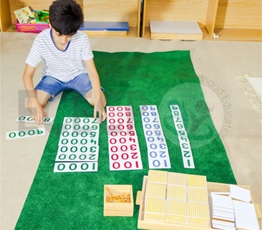
1. Concrete to Abstract Learning Children work with materials like number rods, golden beads, spindle boxes, and bead chains to see and feel mathematical concepts before they are asked to solve them on paper
2. Sequential and Logical Progression
Each material builds on the next. For example, number rods introduce counting, golden beads introduce place value, and bead chains prepare children for multiplication and squaring.
3. Independence and Exploration
Children are free to repeat activities until they feel mastery. This independence fosters confidence, curiosity, and a genuine love of learning math.

4. Hands-On Arithmetic
Addition, subtraction, multiplication, and division are first learned through physical exchanges of beads and materials, helping children understand the “why” behind operations.
Benefits of Montessori Math
Deep Understanding of Concepts: Children truly grasp place value, the decimal system, and arithmetic.
Confidence in Problem-Solving: Math feels fun, approachable, and meaningful.
Stronger Memory Retention: Hands-on learning connects abstract concepts to real experiences.
Lifelong Love for Mathematics: Instead of fear, children associate math with discovery and success.
Conclusion
Montessori Math is not just about learning numbers , it’s about building a lifelong relationship with mathematics. By turning abstract concepts into concrete experiences, Montessori education ensures children grow into confident learners who are not only skilled in math but also curious, logical, and creative thinkers.

At ECECP (Early Childhood Education & Care Pakistan), we train future educators to use Montessori math materials effectively, giving children the best possible start in their mathematical journey.
🌐 www.ececp.ac.pk
📞 0344-5043107